
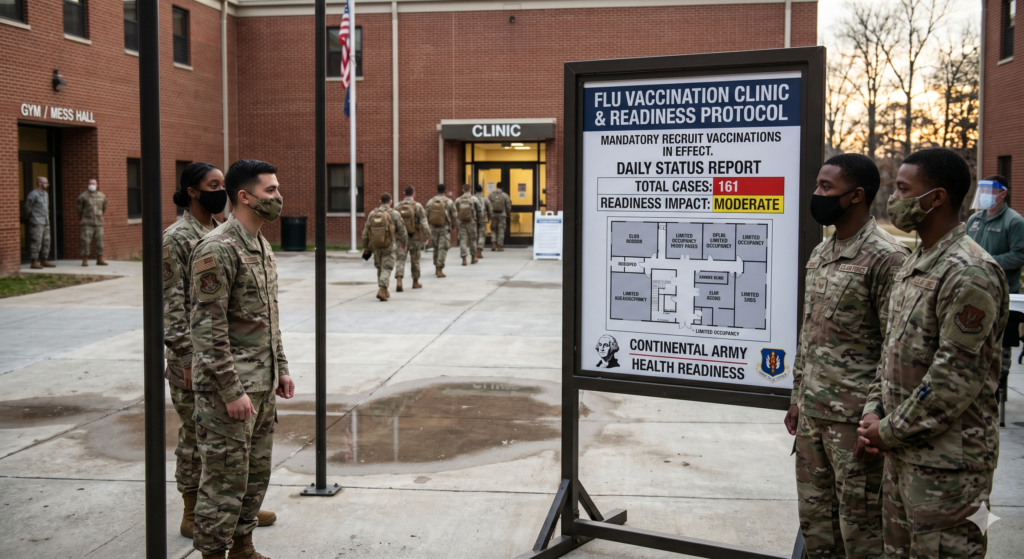
A severe influenza outbreak at Lackland Air Force Base in Texas has exposed the immediate dangers of weakening military health standards. In a span of just a few weeks, the virus has infected nearly 160 personnel and is suspected of causing the tragic death of a basic training recruit. This sudden medical crisis serves as a stark warning about the consequences of Defense Secretary Pete Hegseth’s spring decision to eliminate the military’s universal mandate for the flu shot. Since the policy was rolled back, voluntary uptake has plummeted, with fewer than half of all Air Force recruits choosing to receive the vaccine.
While no vaccine offers absolute protection, the flu shot remains a vital tool for force preservation. It significantly reduces the probability of catching the virus, diminishes the severity of symptoms for those who do fall ill, and severely restricts transmission rates. Data from previous years demonstrates that the vaccine lowered the risk of illness by roughly 36 percent, showing even greater efficacy among younger, healthier adults—the exact demographic currently entering basic training.
The situation unfolding at Lackland is a frustratingly preventable reminder of how rapidly respiratory illnesses can compromise operational capabilities in a military environment. Service members are routinely subjected to high-density environments, sharing tightly packed barracks and eating meals at communal tables. Under these conditions, a highly contagious virus behaves like wildfire.
History provides a grim blueprint of this reality. Across centuries of warfare, invisible pathogens have consistently claimed more military lives than enemy combatants. During the American Civil War, for example, uncontrolled infectious diseases were responsible for an estimated two-thirds of all military fatalities. This vulnerability is exactly why strategic leaders have historically prioritized medicine over politics; as early as 1777, General George Washington famously ordered the mandatory inoculation of the Continental Army against smallpox specifically to safeguard the army’s combat readiness.
When the current Defense Secretary dismantled these protections, he framed the decision around the ideas of personal liberty and tactical strength, claiming that sweeping mandates actively weakened war-fighting capabilities. In reality, the decision appears to be an act of political pandering to anti-vaccine elements within the administration’s broader political coalition. This push continues under Health Secretary Robert F. Kennedy Jr., who has consistently worked to restrict vaccine accessibility despite the fact that top executive leaders have historically chosen to receive their own immunizations.
Fortunately, the policy change left room for a critical safeguard: individual branches retain the authority to implement targeted mandates under exceptional circumstances. Recognizing the severity of the Lackland outbreak, Air Force officials successfully secured a local exemption to the rule. This bureaucratic workaround has finally allowed commanders to mandate flu shots for the recruits stationed at the San Antonio facility. While leadership cannot command seasonal viruses to stop mutating, voluntarily abandoning proven preventative countermeasures only serves to actively erode the readiness of America’s armed forces.