
The landscape of managing chronic illnesses is undergoing a monumental shift. For the first time in over a century, the medical community is moving beyond the standard reliance on insulin therapy to combat type 1 diabetes. Following a landmark decision by the National Institute for Health and Care Excellence (NICE), the innovative immunotherapy drug teplizumab has officially been approved for use within the UK. Patient advocacy groups, including Diabetes UK, have hailed this regulatory greenlight as the dawn of a completely new epoch in metabolic medicine—one focused on tackling the underlying cause of the disease rather than merely mitigating its lifelong symptoms.
Targeting the Root Cause
Teplizumab, marketed under the brand name Tzield and manufactured by the pharmaceutical company Sanofi, functions fundamentally differently from conventional diabetes interventions. Type 1 diabetes is an autoimmune condition where the body’s own immune system mistakenly identifies insulin-producing beta cells in the pancreas as foreign threats and systematically destroys them. Teplizumab acts as an immunomodulator, essentially retraining the immune system to halt this self-destructive assault.
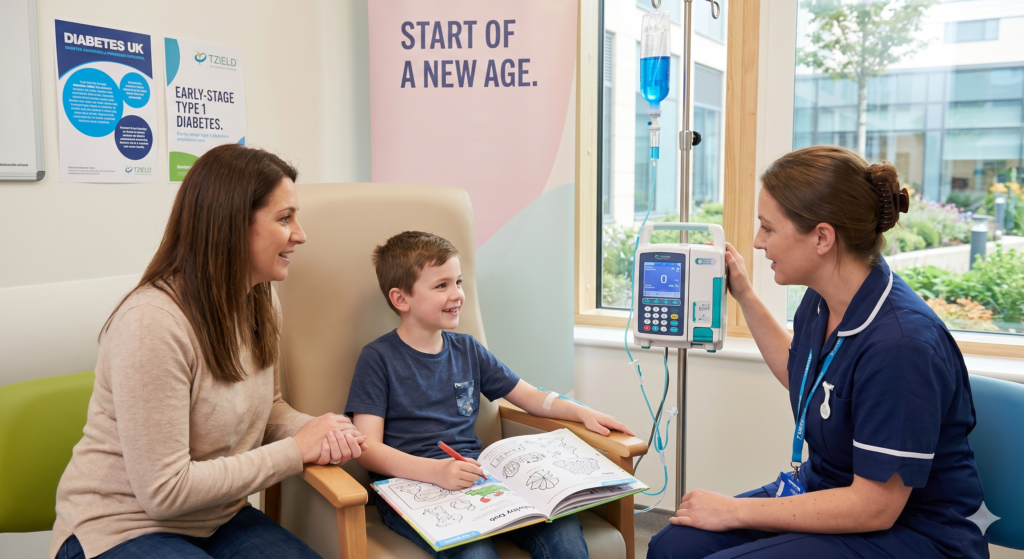
The treatment is specifically approved for adults as well as children aged eight and older who have been diagnosed with early-stage, pre-symptomatic type 1 diabetes. Rather than a permanent daily regimen, teplizumab is administered as a one-time course. Patients receive the medication via an intravenous drip once a day for 14 consecutive days. Clinical evidence demonstrates that this brief intervention can successfully delay the full onset of clinical type 1 diabetes for several years, giving patients invaluable time to live without the immediate, grueling demands of intensive blood sugar management.
A Century-Long Breakthrough
The significance of this approval cannot be overstated. Since the discovery and first successful clinical application of therapeutic insulin in the early 1920s, the core strategy for treating type 1 diabetes has remained structurally unchanged: patients must carefully monitor their blood glucose levels and inject external insulin multiple times a day to survive.
“For the first time in 100 years, we are moving beyond insulin, with a medicine that targets the root cause of the condition,” noted Dr. Elizabeth Robertson, Director of Research at Diabetes UK. She described the approval as an extraordinary moment of celebration, signaling a progressive shift toward a future where the condition might eventually be prevented altogether.
For the estimated 400,000 individuals currently living with type 1 diabetes across the UK, the daily reality involves an unyielding routine of finger-prick tests, carbohydrate counting, and constant adjustments to insulin pumps or injections. By postponing the clinical phase of the disease, teplizumab grants vulnerable children and adults precious years of freedom from these intense daily pressures. Furthermore, it provides families with vital psychological and practical breathing room to educate themselves and prepare for future management.
Projecting the Impact and the Role of Screening
According to projections by NICE, approximately 1,100 individuals will meet the strict eligibility criteria for the therapy within its first year of deployment. That number is expected to stabilize at roughly 820 patients annually in subsequent years.
| Metric | Details |
| First-Year Eligible Patients | 1,100 individuals |
| Subsequent Annual Baseline | 820 individuals |
| Treatment Delivery Window | 14 consecutive daily IV infusions |
| Target Demographic | Adults & children aged 8+ (Pre-symptomatic stage) |
Because teplizumab is uniquely effective before clinical symptoms manifest, its success is fundamentally tethered to early detection. Consequently, widespread population screening has become the next major frontier for healthcare researchers. In the UK, two pioneering initiatives are currently evaluating screening methodologies to identify at-risk individuals before pancreatic damage becomes irreversible.
The Early Surveillance for Autoimmune Diabetes (Elsa) study, backed by Diabetes UK and Breakthrough T1D, is actively evaluating pediatric subjects between the ages of two and 17. Concurrently, a separate initiative known as the T1DRA study is focusing its screening efforts on adults aged 18 to 70.
The ultimate ambition shared by research advocates and health service partners is to transition these localized studies into a standardized, nationwide screening framework. By embedding early autoimmune detection into routine public health systems, the medical community aims to ensure that every individual developing early-stage type 1 diabetes can access these protective immunotherapies before structural damage occurs.