
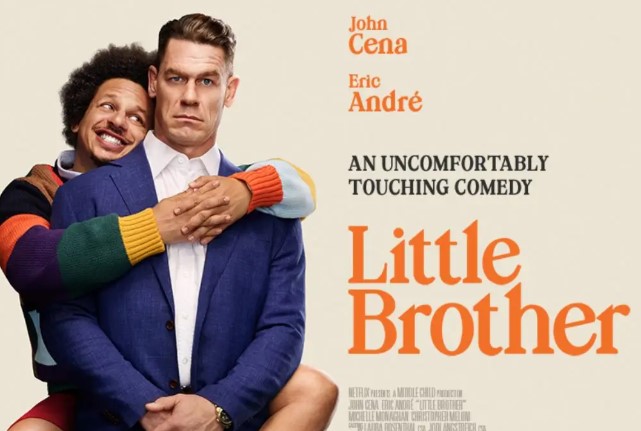
John Cena and Eric André star in this crude, chaotic, and surprisingly sweet streaming romp.
The classic “slob vs. square” formula is as old as Hollywood itself. We’ve seen it work beautifully in Planes, Trains and Automobiles, and we’ve seen it falter in dozens of uninspired copycats. But when you throw the physical powerhouse sincerity of John Cena against the absolute unhinged, surrealist chaos of Eric André, the blueprint gets a frantic, R-rated upgrade. Directed by Matt Spicer (Ingrid Goes West), Netflix’s Little Brother doesn’t exactly reinvent the wheel, but it spins it fast enough to deliver one of the most watchable, unapologetically crude comedies of the year.
At the center of this storm is Rudd Landy (John Cena), a hyper-successful, tightly wound New York City real estate agent. Rudd has painstakingly curated his perfect life: a gorgeous home, two teenage sons, and a supportive wife, Deirdre (played with surprising comedic edge by Michelle Monaghan). Rudd’s current obsession is securing a spot on NYC Hustlers, a cutthroat reality TV show designed to finally launch him out of the shadow of his obnoxious, billionaire older brother, Josh (Christopher Meloni). Rudd’s calendar is color-coded, his posture is rigid, and his patience is thin.
Enter Marcus Pinchel (Eric André).
Marcus is Rudd’s former “little brother” from a mentorship program three decades prior. Thanks to a well-intentioned but highly problematic catfishing subplot involving Rudd’s assistant Mia (Sherry Cola)—who has been replying to Marcus’s emails in character as Rudd—Marcus believes his long-lost mentor is dying to reconnect. After busting out of a mental healthcare facility, Marcus tracks Rudd down and completely upends his carefully manicured existence.
Where the film truly succeeds is in the brilliant casting inversion. John Cena, who has repeatedly proven his comedic chops in projects like Peacemaker and Ricky Stanicky, plays the straight man here. He channels the exasperated, vein-popping energy of Richard Dreyfuss in What About Bob?, acting as the anchor for the movie’s madness. Cena understands that the funniest thing a massive, muscular man can do is try—and fail—to keep his cool while his life implodes.
Eric André, conversely, does exactly what Eric André does best: he obliterates social boundaries. Marcus is a walking disaster zone of impulsive decisions, physical pratfalls, and boundary-shattering oversharing. The film features a heavy dose of scatological and gross-out humor—including a highly graphic, window-shattering public urination sequence from a moving car that feels ripped straight out of a Jackass film.
Yet, beneath the layers of bodily fluids and smutty dialogue, Little Brother harbors a surprising amount of genuine heart. Marcus isn’t just an agent of chaos; he’s a deeply lonely, abandoned soul looking for a family. André balances his trademark cringe-inducing mania with a vulnerability that makes it impossible to completely hate him, even as he systematically dismantles Rudd’s career. The supporting cast shines as well, particularly Meloni’s livewire performance and Monaghan, who gets to participate in some shockingly raunchy bits rather than just playing the disapproving wife.
Written by Jarrad Paul and Andrew Mogel, the script sometimes drops its most interesting thematic threads—such as a sharp critique of how private charities are forced to substitute for failing social safety nets. The movie is not a cinematic masterpiece, and it occasionally lapses into predictable streaming-slop pacing.
However, buddy comedies live and die entirely on chemistry. Little Brother proves that John Cena and Eric André are an oddly perfect match. It’s a nostalgic throwback to the unfiltered, mid-2000s studio comedies—a gleefully dumb, fiercely funny romp that reminds us just how entertaining it is to watch two total opposites get stuck with each other.