
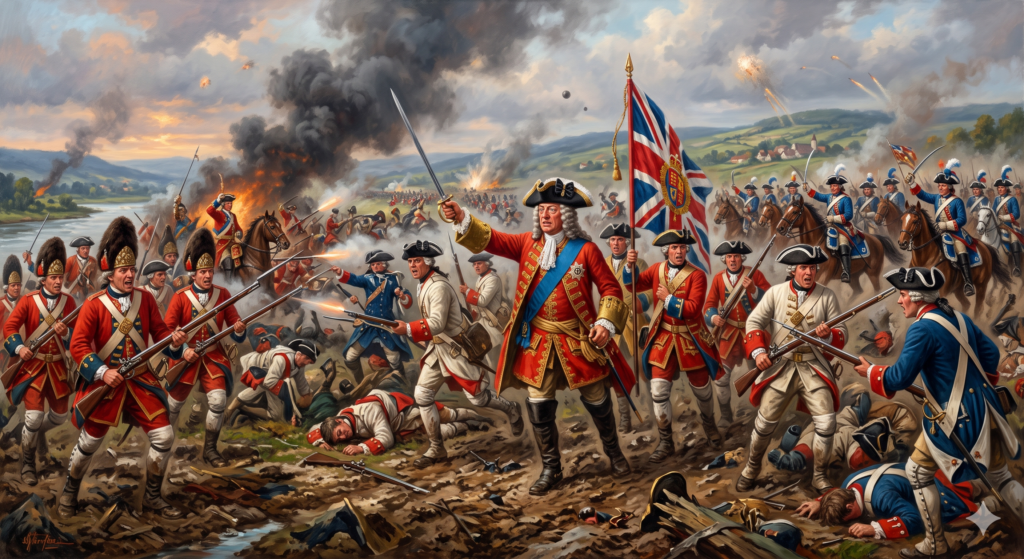
The image of a king leading his army from the front lines, sword drawn and armor gleaming, is deeply woven into the fabric of historical lore. For centuries, the legitimacy of a ruler was intrinsically tied to their prowess on the battlefield. However, as warfare evolved into an increasingly industrialized and lethal affair, the role of the monarch shifted from active commander to symbolic figurehead. The definitive turning point in this evolution occurred on June 27, 1743, at the Battle of Dettingen, marking the final time a reigning British monarch led troops into active combat.
The Road to Dettingen
The conflict that brought King George II to the battlefields of Bavaria was the War of the Austrian Succession (1740–1748). A complex European struggle sparked by the ascension of Maria Theresa to the Austrian Hapsburg throne, the war quickly drew in the continent’s major powers. Great Britain, eager to maintain the balance of power and protect the King’s ancestral homeland of Hanover, allied with Austria against a formidable French coalition.
By the summer of 1743, a combined force of British, Hanoverian, and Austrian troops—collectively known as the “Pragmatic Army”—found themselves in a perilous position. Heavily outmaneuvered by the French forces under the command of the Duke of Noailles, the Allied army was trapped along the northern bank of the River Main near the village of Dettingen. Facing starvation and constant artillery bombardment, the Allies had little choice but to attempt a desperate breakout.
George II: A Soldier-King in the Fray
Unlike his successors, George II was a man of distinct military background. Born and raised in Germany, he possessed a deep passion for soldiering and had previously seen action at the Battle of Oudenarde in 1708. When news reached him of the Pragmatic Army’s dire predicament, the 59-year-old monarch refused to remain a passive spectator in London. He traveled to the continent to take personal command of his forces.
On the morning of June 27, as the French forces closed in, George II donned his military regalia and rode among his men to boost morale. The situation quickly turned chaotic. The King’s horse, terrified by the thunderous roar of French cannon fire, bolted and nearly carried the monarch directly into the enemy lines. Undeterred, George II dismounted, drew his sword, and famously rallied his infantry on foot, reportedly shouting, “Now, boys, for the honor of England! Fire, and behave bravely, and the French will soon run!”
The King’s physical presence and unwavering composure acted as a powerful catalyst. Inspired by the sight of their sovereign fighting alongside them in the mud and smoke, the British and Allied infantry held their ground against furious French cavalry charges. Due to a tactical blunder by the French secondary commander, who abandoned a secure defensive position to attack prematurely, the Allies managed to turn the tide. The French lines shattered, resulting in a decisive, albeit unexpected, victory for the Pragmatic Army.
The Twilight of the Warrior Monarch
While the Battle of Dettingen was celebrated as a grand triumph in London—even inspiring George Frideric Handel to compose his famous Dettingen Te Deum—it marked the end of an era. The political establishment in Britain grew intensely uncomfortable with the concept of a reigning monarch risking their life on foreign battlefields. Had George II been captured or killed, it would have triggered a catastrophic constitutional and succession crisis at home.
As the 18th century progressed, the nature of constitutional monarchy solidified, and the British government took firm control over military deployments. Future monarchs would continue to hold honorary military ranks and visit troops to offer encouragement, but the days of a king actively directing strategy amidst the gunfire were permanently over.
George II’s stand at Dettingen remains a fascinating historical milestone. It stands as the final, dramatic chapter of an ancient tradition, closing the book on the era of the true British warrior-king.