
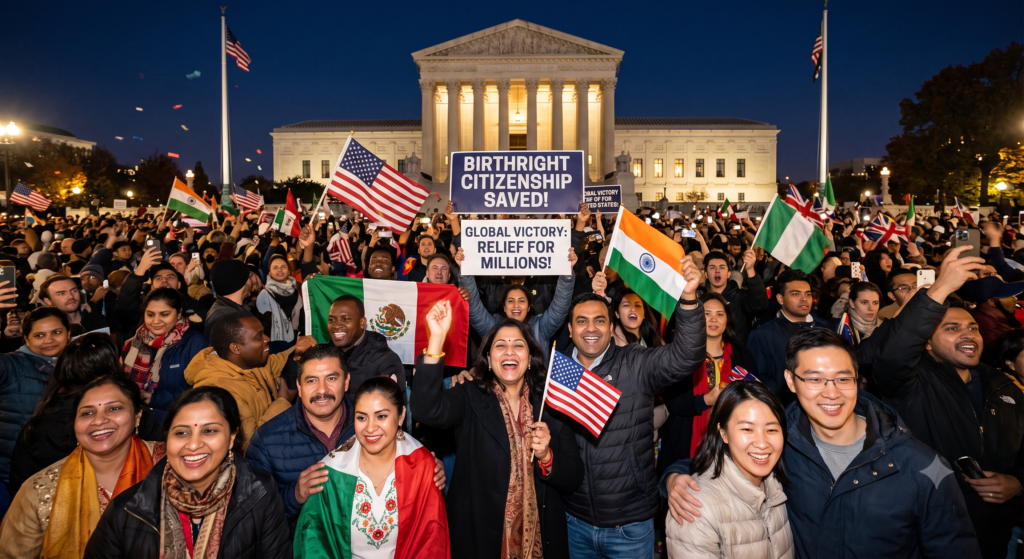
The legal corridors of Washington, D.C., recently witnessed a landmark showdown that sent waves of relief across the globe. In a highly anticipated and fiercely debated case, the United States Supreme Court delivered a definitive ruling against the proposed restrictions on Birthright Citizenship—a cornerstone policy championed by former President Donald Trump.
For millions of immigrant families worldwide—spanning Asia, Latin America, Africa, and Europe—this verdict is not just a legal victory; it is a profound validation of their sacrifices, their contributions, and their children’s future security.
The Core of the Conflict: What is Birthright Citizenship?
At the heart of this legal battle lies the 14th Amendment of the U.S. Constitution, which explicitly states that anyone born on U.S. soil is automatically a United States citizen. Historically, this principle has acted as the ultimate equalizer, offering a clean slate and immediate integration into the American fabric regardless of a family’s nationality, race, or immigration status.
During his political campaigns and administration, Donald Trump repeatedly challenged this constitutional guarantee. His legal team argued that the 14th Amendment was never intended to grant automatic citizenship to the children of undocumented immigrants or temporary visa holders. The proposed policy shift aimed to strip away this automatic right, sparking immense anxiety among millions of global immigrants.
A Universal Relief: Why the World is Celebrating
The threat to birthright citizenship hit the global immigrant community uniquely hard, affecting families from all walks of life and all corners of the world.
1. Protection for Vulnerable and Undocumented Families
For millions of undocumented immigrants from Latin America and other regions, birthright citizenship was the one beacon of hope that promised their children a life free from the shadows. The Supreme Court’s ruling ensures that these children will not be punished for their parents’ legal status, protecting them from the threat of deportation and statelessness.
2. Security for Global Tech and Professional Workers
The U.S. attracts top-tier talent from across the globe—including India, China, Europe, and Canada—on temporary work visas (such as H-1B, L-1, and O-1). Due to extensive green card backlogs, many of these professionals live in visa limbo for decades. If birthright citizenship had been dismantled, children born to these global professionals would have faced an uncertain legal status. The verdict guarantees that their children are recognized as rightful citizens from day one.
3. Upholding Family Unity and Stability
If the challenge had succeeded, it would have created complex humanitarian crises. Parents could have faced scenarios where their children were rendered citizens of countries they had never even visited.
“The Supreme Court’s ruling is a triumph of constitutional integrity over political division. It reassures millions of hardworking global citizens that America remains a land of opportunity for the next generation.”
The Economic and Cultural Impact on a Global Scale
The United States has always been a mosaic of global cultures. From Silicon Valley tech innovators and Wall Street analysts to frontline healthcare workers and agricultural builders, immigrants drive the engine of the American economy.
By safeguarding the 14th Amendment, the Supreme Court has effectively secured the next generation of global-American leadership. The children of these millions of immigrants will continue to grow up as full citizens, eligible for higher education, voting rights, and leadership roles—allowing them to contribute seamlessly to global innovation and progress without structural glass ceilings.
A Binding Legal Precedent
The Supreme Court’s decision sends a clear, legally binding message: The core tenets of the U.S. Constitution cannot be rewritten by executive whims. Legal experts note that this ruling firmly entrenches the interpretation of the 14th Amendment, making it exceedingly difficult for future administrations to mount similar challenges without a literal constitutional amendment—a near-impossible political feat.
While the broader debate surrounding comprehensive immigration reform in the United States remains complex, this specific verdict provides a massive sigh of relief to the entire international community.
Conclusion
The headlines declaring “Supreme Court mein Trump haare” represent far more than a localized political win; they signify the endurance of human dignity and the American Dream on a global stage. For millions of families watching anxiously from every corner of the earth, the Supreme Court did not just uphold a law—it protected the universal right of their children to smile, thrive, and call the land they were born in their home.