
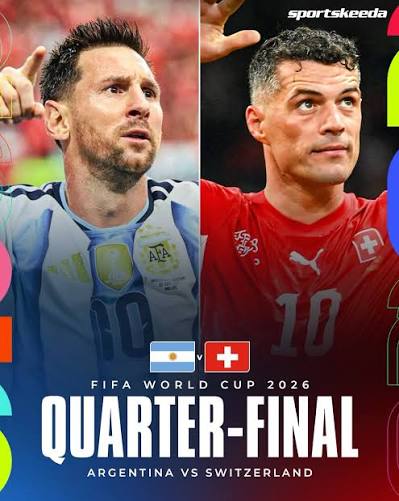
The stage was set at a raucous Kansas City Stadium for a high-stakes 2026 FIFA World Cup quarterfinal, a match that promised elite tactical chess and delivered an absolute rollercoaster of human drama. When the final whistle blew deep into extra time, defending champions Argentina had secured a hard-fought 3-1 victory over a valiant, short-handed Switzerland side. The victory sets up a tantalizing semifinal clash against England in Atlanta, but the path to get there required every ounce of resilience the South American giants could muster.
An Emotional Opening and Early Dominance
Before a ball was even kicked, an air of solemn history hung over the Argentine squad. Wearing black armbands, Lionel Scaloni’s men took the pitch to pay tribute to the legendary Antonio Ubaldo Rattín, the iconic former captain who had passed away at the age of 89. Spurred on by the emotional homage, La Albiceleste standard-bearer Lionel Messi wasted no time stamping his authority on the match.
In the 10th minute, Messi floated a signature, pin-point corner kick into the heart of the Swiss penalty area. Arriving with perfect timing was midfielder Alexis Mac Allister, who thudded a powerful header past Swiss goalkeeper Gregor Kobel to give the reigning champions a dream 1-0 lead. For the remainder of the first half, Argentina looked entirely in control, dictated by the midfield orchestration of Enzo Fernández and Rodrigo De Paul, while the Swiss struggled to string meaningful attacks together.
The Swiss Resurgence and VAR Controversy
The second half told a completely different story. Refusing to let their World Cup journey end without a fight, Switzerland emerged from the tunnel with renewed vigor. Their persistence paid off in the 67th minute. Capitalizing on a swift attacking sequence, Ricardo Rodríguez threaded a sharp ball to Dan Ndoye, who fired a brilliant right-footed strike into the center of the net, silencing the traveling Argentine contingent and leveling the score at 1-1.
Just as momentum swung toward the European side, the match erupted into controversy. Five minutes after the equalizer, Switzerland’s star forward Breel Embolo was involved in a midfield tangle with Leandro Paredes. Having already received a yellow card in the first half, Embolo watched in horror as a VAR review concluded he had simulated contact before Paredes made a challenge. The referee brandished a second yellow, followed by a red card. Reduced to 10 men, Murat Yakin’s side was forced into a desperate, defensive shell for the remainder of regulation, successfully dragging the match into a grueling extra-time period.
Overtime Break and the Knockout Blow
With a one-man advantage, Argentina subjected the Swiss backline to a relentless siege during extra time. Substitute Thiago Almada went agonizingly close, striking the side netting, while Lionel Messi repeatedly cut inside to unleash dangerous efforts. However, Swiss keeper Gregor Kobel stood like a monolithic wall, pulling off a string of spectacular saves to keep his country’s Cinderella story alive.
The heroic Swiss resistance finally fractured in the 112th minute. Wave after wave of Argentine pressure culminated when Julián Alvarez found space inside the box and slotted home a clinical finish, restoring Argentina’s lead and sending the stadium into euphoria.
As Switzerland threw everyone forward in a desperate, final-minute gamble to equalize, Argentina struck on the counter. In the 120th minute, Lautaro Martínez capitalized on the completely exposed Swiss defense, tapping in a third goal to seal the 3-1 victory and punch Argentina’s ticket to the final four.
A Global Audience Glued to the Screens
The dramatic nature of the knockout match drew unprecedented global viewership. Across the world, millions of fans scrambled to catch the action live. Football enthusiasts turned to prominent digital guides, such as PCMag, to navigate the complex landscape of broadcasting rights and uncover free live-streaming options via platforms like ITVX in the UK, SBS On Demand in Australia, and various regional network apps. Whether watching inside a packed stadium in Missouri or streaming on mobile devices across continents, the world witnessed a modern World Cup classic. Argentina marches on, their dream of back-to-back global titles remaining firmly alive.