

In a historic milestone for synthetic biology, researchers at Stanford University and the Arc Institute have accomplished what was once confined to science fiction: using generative artificial intelligence to design entirely functional, novel biological viruses from scratch. Published in the journal Science, the breakthrough represents the first time an AI model has written the complete, executable genetic instruction manual for a viable biological entity. By synthesizing these AI-designed genomes in the laboratory, scientists created 16 brand-new bacteriophages—viruses that target and kill bacteria—that do not exist anywhere in nature. Dubbed by genomics experts as “biology’s Wright Brothers moment,” the achievement marks a fundamental transition from editing pre-existing life to algorithmically generating new forms of it.
How AI Learns the Language of DNA
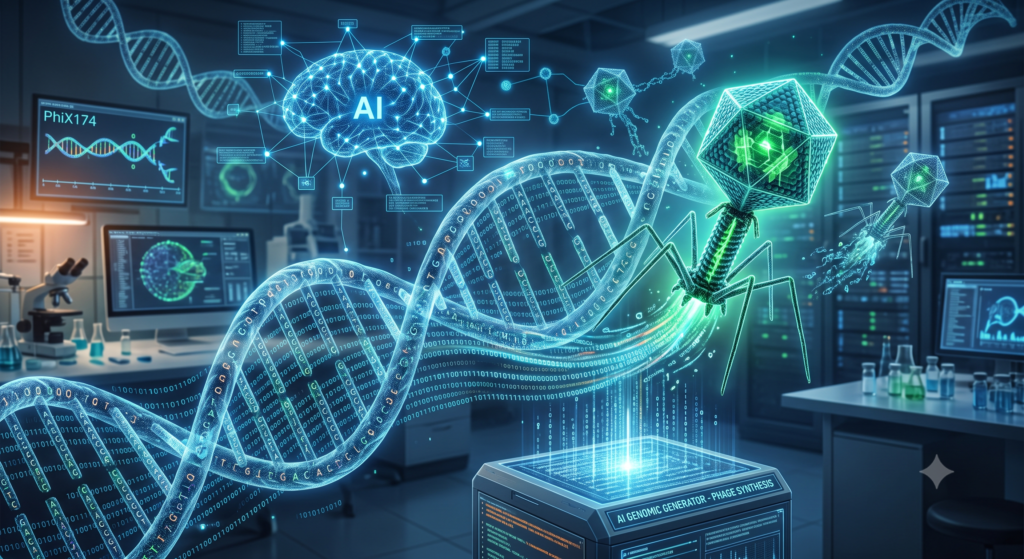
The computational engine behind this feat is a genomic foundation model known as Evo (specifically its updated iteration, Evo 2). Operating much like large language models such as ChatGPT, Evo processes biological code instead of human text. Where language models predict the next word in a sentence, Evo analyzes biological sequences composed of the four basic DNA chemical letters: Adenine (A), Cytosine (C), Guanine (G), and Thymine (T). Trained on billions of nucleotide sequences across millions of organisms, the model learned the subtle structural rules, regulatory patterns, and functional “grammar” governing life. When tasked with designing viral code based on the classic PhiX174 phage template, Evo produced hundreds of thousands of candidate genomes. Scientists synthesized selected candidate sequences in the lab and introduced them into host bacteria, which obediently read the artificial instructions and built fully active, replicating viral particles.
A New Weapon Against Antibiotic Resistance
The immediate medical promise of AI-designed viruses lies in combating one of humanity’s most daunting healthcare crises: antimicrobial resistance (AMR). As superbugs increasingly evolve immunity to standard antibiotics, traditional treatments are failing. Phage therapy—using specialized viruses to hunt and destroy specific bacterial pathogens—has long offered an alternative, but natural phages often take months to source, test, or adapt.
The AI-generated bacteriophages developed in the Stanford study demonstrated remarkable efficacy, wiping out strains of E. coli that had developed resistance to natural viruses. Some of the AI-created viruses even multiplied faster than their natural counterparts. By leveraging AI to rapidly generate targeted viral therapies tailored to specific resistant strains, scientists could soon deploy custom-designed biological agents capable of neutralizing dangerous superbugs faster than the bacteria can evolve resistance.
The Biosecurity Paradox
Yet, the ability to write functional viral genomes on a computer keyboard inevitably casts a shadow over global biosecurity. While the Stanford researchers implemented strict safety protocols—deliberately omitting human, animal, and plant pathogens from the AI’s training data—the underlying technical principles are universal.
Experts in health security warn that generative genomics drastically lowers the technical barrier to creating complex biological agents. Because foundation models like Evo 2 are open-source and freely accessible, the risk of dual-use application looms large. If software can be prompted to write beneficial phages, the same computational frameworks could theoretically be adapted by malicious actors to engineer novel human pathogens, alter viral transmissibility, or bypass existing immune defenses and DNA synthesis screening tools.
Governance and the Road Ahead
The rapid emergence of AI-driven synthetic biology highlights a critical gap between technological capabilities and legal policy frameworks. Current biosecurity regulations, gene synthesis screening rules, and safety protocols were created for an era when modifying biological organisms required painstaking physical lab experimentation. They were not built for a reality where generative algorithms can dream up viable genomes in seconds.
Leading biosecurity analysts emphasize that while banning computational research is both impractical and counterproductive, the global scientific community must establish robust guardrails. This includes mandatory identity verification for DNA synthesis orders, rigorous output filtering on biological AI models, and international agreements governing dual-use synthetic biology.
The creation of the world’s first AI-designed viruses is a profound double-edged sword. It showcases the astonishing power of artificial intelligence to unravel biological complexity and offer life-saving weapons against drug-resistant diseases. At the same time, it serves as an urgent wake-up call: humanity has officially entered an era where software can write life into existence—making the task of establishing responsible oversight as critical as the science itself.