
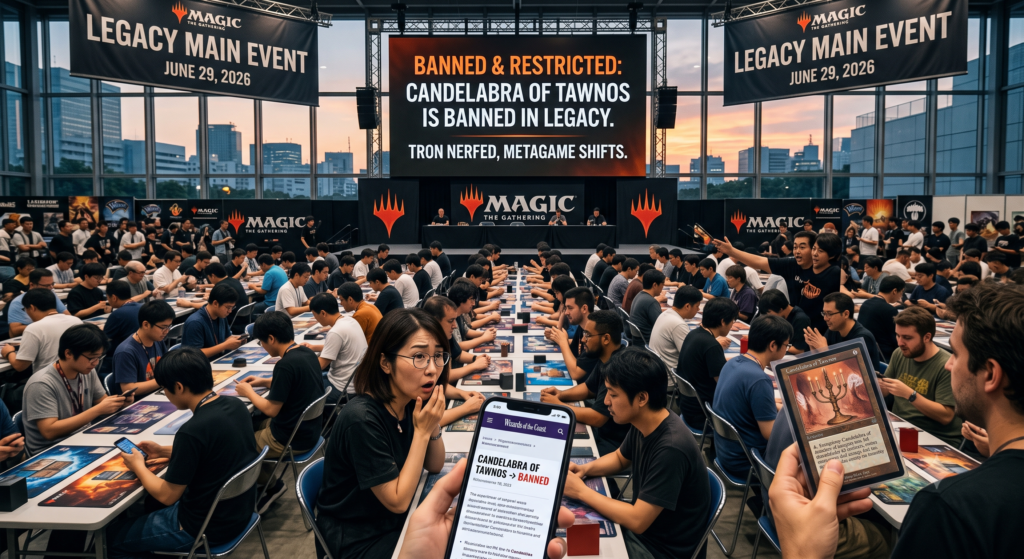
In a move that has sent shockwaves through the eternal Magic: The Gathering community, Wizards of the Coast (WotC) has officially banned the iconic, ultra-rare artifact Candelabra of Tawnos from the Legacy format.
The sudden removal of this classic piece of Magic history headline’s WotC’s June 29, 2026, Banned & Restricted announcement. While other constructed and digital formats also saw minor shifts, the legacy banning of an original Antiquities powerhouse has ignited intense debate over format health, card pricing, and the controversial Reserved List.
Dimming the Power of Colorless Tron
According to the official statement from Wizards of the Coast, the decision to target Candelabra of Tawnos stems from the explosive rise of the Colorless Tron archetype in the competitive Legacy metagame.
Traditionally a mainstay of the Modern format, Tron strategies leverage specific combinations of resource-heavy lands to generate massive amounts of colorless mana quickly. Armed with modern innovations like Ugin’s Labyrinth and The One Ring, Legacy Tron has rapidly claimed a concerningly large share of the competitive tier list.
[X Generic Mana] -> Tap Candelabra -> Untap X High-Value Lands -> Massive Mana Generation
Even as the metagame tried to adapt, the deck’s win rate remained overwhelmingly high, prompting WotC to step in preemptively. In their commentary, developers noted that Candelabra of Tawnos—which filters generic mana to untap multi-mana yielding lands—was the exact engine piece most likely to cause long-term structural issues for Legacy. By extracting the artifact, WotC hopes to lower the deck’s explosive ceiling without completely destroying the viability of colorless ramp strategies.
The Reserved List Factor: A $17,000 Dilemma
Beyond the mechanical implications of the ban, the removal of Candelabra of Tawnos has re-opened a massive philosophical debate regarding the accessibility of Eternal formats.
Because Candelabra of Tawnos belongs to the infamous Reserved List—a decades-old pledge by WotC never to functionally reprint certain early cards—the physical supply of the card is strictly limited. Over the years, this artificial scarcity drove individual copies of the artifact up to $3,000 to $4,000 each, pushing optimal paper paper builds of Legacy Tron to an astronomical total cost of over $17,000.
Within player communities, reactions have been a mix of relief and fascination. Many competitive players noted that leaving the card unbanned ahead of major upcoming competitive events would have triggered a logistical disaster, forcing players into a frantic scramble to buy or borrow thousands of dollars worth of incredibly scarce cardboard.
Conversely, some collectors feel frustrated that one of the format’s most expensive status symbols has been relegated to the sidelines, though others point out that its secondary market value remains heavily anchored by vintage collectors and Commander enthusiasts.
Collateral Damage and Metagame Shakeups
While Tron was the undisputed target, the ban has dealt an unintended death blow to one of Legacy’s oldest, most nostalgic archetypes: High Tide. High Tide decks relied on using the titular blue instant alongside Candelabra of Tawnos to generate infinite or near-infinite mana off basic Islands, culminating in a massive game-ending spell like Brain Freeze or Blue Sun’s Zenith. Though High Tide has drifted out of the top tiers of modern competitive play, purists are mourning the loss of a format staple.
Meanwhile, the rest of the June 29 announcement brought targeted adjustments to other areas of the game. Pauper saw the banning of Seeker of Skybreak to instantly dismantle a problematic infinite-damage combo involving the recently released Hawkeye’s Bow. Additionally, traditional Brawl on MTG Arena underwent a sweeping ban of several premium counterspells and fast-mana pieces (including Force of Will and Ugin’s Labyrinth) in an explicit effort to push the format back toward casual, multiplayer-friendly gameplay.
What Lies Ahead for Legacy?
The banishment of Candelabra of Tawnos marks a bold chapter for the management of Magic’s oldest formats. It proves that Wizards of the Coast is willing to pull the trigger on high-profile, high-value cards if their gameplay patterns threaten the competitive landscape. As the dust settles, Legacy players will be watching closely to see if Colorless Tron can survive on pieces like Manifold Key alone, or if the format’s balance of power will shift back toward more conventional blue-red tempos and control strategies.