
When Christopher Nolan sets his sight on classical antiquity, he does not simply adapt history or myth—he subjects it to psychological deconstruction. In his cinematic take on Homer’s The Odyssey, Nolan transforms Western literature’s foundational voyage from an episodic, monster-filled adventure into a haunting, existential character study. While keeping the essential narrative backbone of the Greek king’s decade-long struggle to return to Ithaca, Nolan alters key thematic, psychological, and structural elements of Homer’s epic to align with his distinct auteur style.
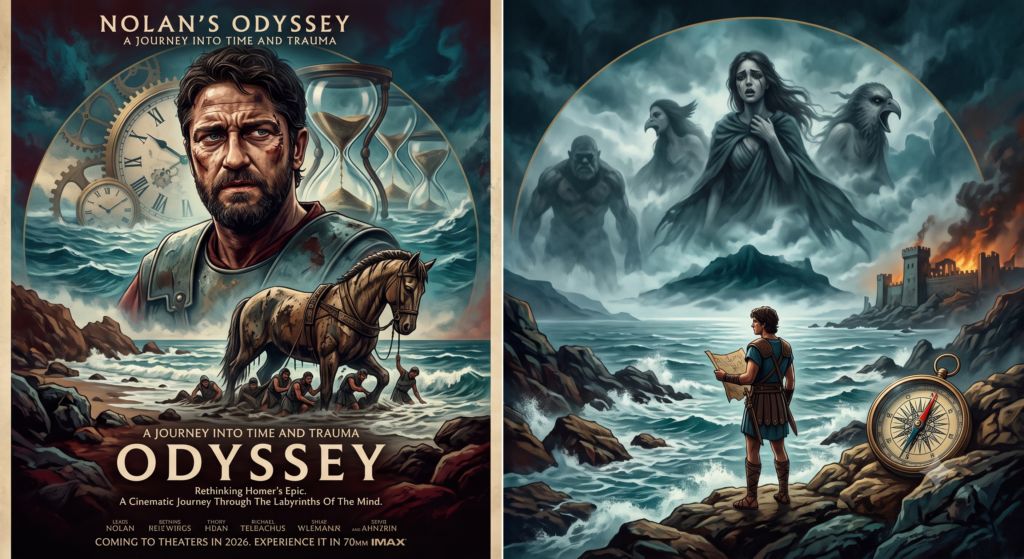
1. From Cunning Trickster to Tormented Anti-Hero
The most dramatic deviation in Nolan’s adaptation lies in the psyche of Odysseus himself. Homer’s hero is famously polytropos—the man of “twists and turns,” celebrated for his sharp wit, deceptive eloquence, and willingness to scheme. He is a classic trickster who takes satisfaction in outsmarting fate.
Nolan strips away the hero’s classic charm and levity. His Odysseus is a brooding, guilt-ridden figure burdened by post-traumatic stress and the moral horrors of the Trojan War. Echoing Nolan’s past protagonists—such as J. Robert Oppenheimer or Bruce Wayne—this version of the Ithacan king is haunted by his choices. His tactical brilliance is reinterpreted not as a glorious attribute, but as a heavy, isolating curse that disconnects him from his humanity.
2. Grounded Realism Over Classical Myth
Where Homer relies on divine intervention and high fantasy—gods descending on gold sandals, literal transformations, and grand spectacle—Nolan grounds the cosmos in physical weight and tactile realism.
A striking example of this subversion is the iconic Trojan Horse. Rather than presenting a towering, triumphant wooden monument standing dry outside Troy’s gates, Nolan depicts the horse half-submerged and sinking into coastal mud. The Greek soldiers huddled inside are not glorious warriors awaiting victory; they are terrified men breathing through straws in rising sea water. This visceral, claustrophobic opening immediately signals that Nolan is dismantling heroic myth-making in favor of raw survivalism.
Similarly, encounters with mythical entities are given psychological framing:
- The Sirens: Instead of singing enchanting, irresistible melodies to lure sailors to destruction, Nolan’s Sirens act as a psychological mirror, psychoanalyzing Odysseus’s deepest regrets and fears.
- Circe: Rather than an arbitrary enchantress, Circe’s island functions as a temporal trap, forcing Odysseus’s men to face their internal degradation.
3. Humanizing the Waiting Family
In Homer’s text, Telemachus and Penelope spend much of the early books isolated in Ithaca, acting as anchors for Odysseus’s eventual return. Nolan restructures the timeline to elevate the father-son relationship, giving Odysseus and Telemachus expanded narrative weight and shared psychological presence.
Telemachus is not merely waiting; he is wrestling with the suffocating shadow of a father he barely knows, mirroring Odysseus’s own fear of becoming a ghost to his family. By shifting focus onto memory, legacy, and the emotional distance caused by time, Nolan turns a linear voyage into a poignant drama about family fractured by war.
4. Practical Spectacle and Temporal Weight
Filmed entirely on 70mm IMAX cameras and utilizing real ships in real waters across the Mediterranean, Nolan rejects digital artificiality. Time itself becomes a tangible adversary. The ten years Odysseus spends lost at sea are felt through physical wear, aging, and relentless environmental force.
By trading Homeric mythic grandeur for psychological depth, historical weight, and intimate character study, Nolan does not simply retell The Odyssey—he transforms an ancient saga into a modern reflection on war, trauma, and the relentless pull of home.