
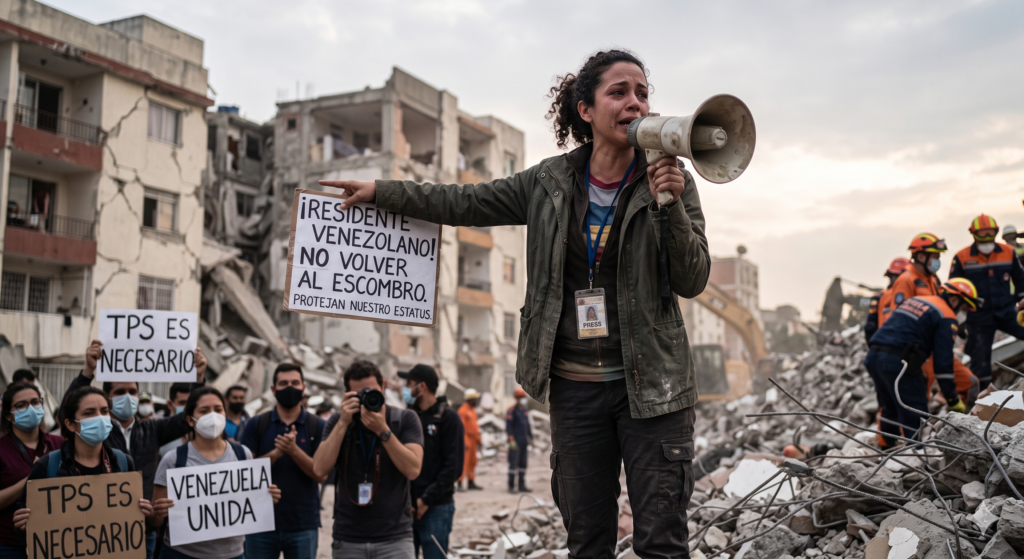
The dust has not yet settled over Caracas and La Guaira. Following the back-to-back 7.2 and 7.5 magnitude earthquakes that recently shattered northern Venezuela, the country is facing an unprecedented humanitarian catastrophe. With hundreds confirmed dead, thousands injured, and a staggering number of people still missing beneath flattened concrete, the nation resembles a literal war zone.
Yet, against this backdrop of immense physical devastation, a secondary crisis is brewing for the millions of Venezuelans who fled the country’s pre-existing political and economic collapse. Amid changing political tides and shifting immigration frameworks in host countries like the United States, the legal safety nets keeping the diaspora safe are under threat.
Recently, prominent Venezuelan journalists and advocates have loudly condemned the Looming threat of revoking temporary humanitarian protections. To force people back to a homeland that has quite literally been reduced to dust is not just a policy shift—it is a human rights failure. As one prominent voice starkly put it, deporting people now means forcing them “back to the rubble.”
A Landscape of Devastation
To understand the weight of this warning, one must look at the reality on the ground in Venezuela. The country was already hollowed out by hyperinflation, severe medical shortages, and broken infrastructure before the seismic shocks hit. The twin earthquakes dismantled what little structural resilience remained.
Hospitals—already lacking basic necessities like gloves and antibiotics—are completely overwhelmed by casualties. Main transit hubs, including the primary airport in La Guaira, suffered severe structural failures, crippling the immediate arrival of international aid. In cities across the northern coast, local residents have been forced to use their bare hands to dig through the debris of collapsed apartment complexes, desperately searching for signs of life.
“The need was already so dire and so great before the earthquake that this is just gonna exacerbate the need even further. Venezuelans cannot go back to this Venezuela.”
— Dulce Suarez, Academy for International Disaster Preparedness
The Hypocrisy of Revoking Humanitarian Protection
Programs like Temporary Protected Status (TPS) in the United States were created by law for precisely this kind of scenario. By definition, TPS is a humanitarian mechanism designed to prevent foreign nationals from being returned to countries experiencing ongoing armed conflict, environmental disasters, or extraordinary, temporary conditions.
Despite this clear legal mandate, the political rhetoric surrounding immigration has increasingly pivoted toward termination and reduction. Hardline immigration policies threaten to strip hundreds of thousands of Venezuelans of their legal right to live and work abroad safely.
Slamming these threats, journalists point out the stark, undeniable hypocrisy of the situation. International leaders, including the U.S. administration, have publicly pledged solidarity and emergency aid to help pull survivors out of the debris. However, keeping deportation pipelines open while sending rescue teams into the disaster zone is a contradiction of the highest order. Sending families back to a country with zero housing, a collapsed healthcare grid, and ongoing aftershocks is a sentence to extreme poverty and physical danger.
The Compounded Trauma of the Diaspora
For the Venezuelan diaspora, the psychological toll of this dual crisis is devastating. Families living abroad have spent grueling days trying to reach loved ones through downed communication grids and severed phone lines. Many are discovering that their childhood homes, neighborhoods, and family members have vanished.
To layer the fear of deportation on top of this acute grief is a form of bureaucratic cruelty. If protected statuses are revoked, individuals who have successfully built lives, contributed to local economies, and sent life-saving remittances back home will be cast into legal limbo. Stripping away their ability to work legally also cuts off the financial lifeline keeping their surviving relatives inside Venezuela alive.
Protection is a Necessity, Not a Luxury
The argument presented by journalists and human rights advocates is clear: humanitarian immigration policy cannot be decoupled from reality. When a nation suffers a catastrophe of this magnitude, the international community has a moral obligation to expand protections, not contract them.
The catastrophic damage to Venezuela’s infrastructure means that recovery will take years, if not decades. It is an environment completely incapable of absorbing repatriated citizens. For host nations to weaponize immigration status during a period of profound mourning and destruction is a violation of basic human empathy.
The message to policymakers worldwide must be unified. Humanitarian protections are not political bartering chips to be traded away for domestic electoral points. Until the dust settles, the infrastructure is rebuilt, and basic human dignity can be guaranteed on Venezuelan soil, there can be no talk of revoking protected status. No one should be forced back to the rubble.