
Every year, Americans pour more than $1 billion into fish oil supplements. A primary driver behind this massive spending is the promise of sharper cognitive performance, fueled by the omega-3 fatty acids packed into these capsules. Omega-3s are well-established as vital nutrients that help construct the intricate brain cell networks required for thinking and memory. Yet, a groundbreaking clinical trial has delivered a sobering reality check to millions hoping to preserve their minds with a daily pill.
A rigorous, two-year study spearheaded by researchers at Keck Medicine of USC and published in the journal eBioMedicine indicates that elevating omega-3 levels through standalone supplements yields virtually no benefit for long-term brain health. Crucially, the trial proved that while the nutrients successfully navigate the bloodstream and enter the brain, they fail to stall cognitive decline.
The double-blind, placebo-controlled investigation specifically tracked older adults who faced a heightened risk of developing Alzheimer’s disease. Even when administered high doses of omega-3s, these participants showed zero improvement in memory capacity or general cognitive function. Furthermore, the supplements did not slow the degradation of brain cells in regions heavily targeted by neurodegenerative disease.
Testing the Biological Target
To uncover these insights, investigators gathered 365 participants between the ages of 55 and 80. Every individual selected rarely consumed fresh fish—nature’s primary source of omega-3s—and each possessed clinical indicators pointing toward future Alzheimer’s risk. Nearly half of the cohort (47%) carried the notorious APOE4 gene variation, which stands as the most aggressive genetic risk marker for late-onset forms of the disease.
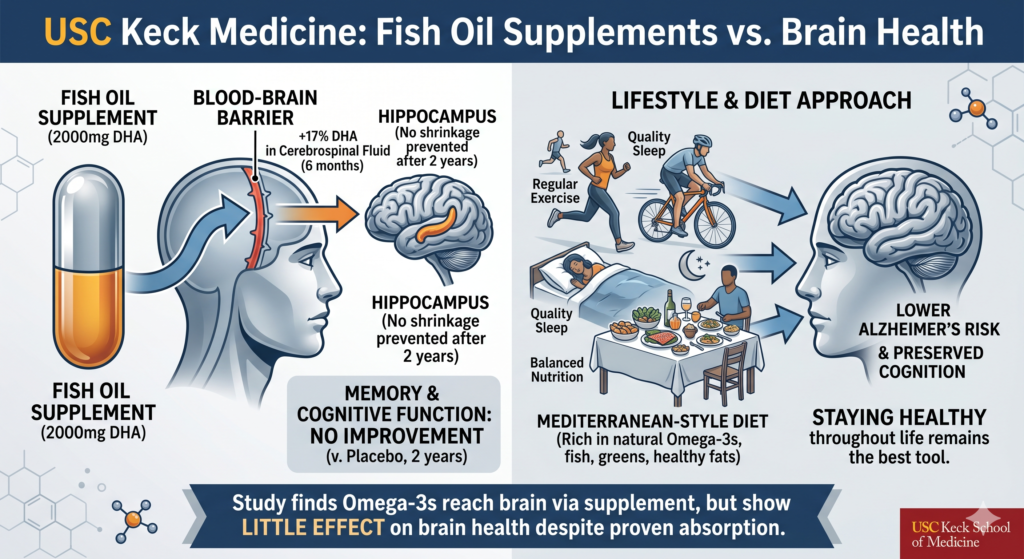
The group was divided randomly, with half taking a placebo and the other half receiving a robust daily dose of 2,000 milligrams of docosahexaenoic acid (DHA), the primary omega-3 fatty acid tied directly to neural operations.
Initially, the scientists wanted to verify if the ingested supplements were even capable of piercing the blood-brain barrier. By analyzing cerebrospinal fluid—the liquid cushioning the brain—six months into the trial, they discovered a encouraging 17% surge in DHA levels. The raw nutrients were undeniably hitting their intended destination.
The Disconnect Between Absorption and Action
However, getting the nutrient into the brain did not translate into functional protection. When researchers evaluated the participants’ cognitive faculties at the start of the study and contrasted them with scores tallied two years later, those taking the high-dose DHA performed no better than the placebo group.
Equally discouraging were the neuroimaging results. Advanced brain scans revealed that the supplements offered no shield against the physical deterioration of the hippocampus. As the central hub for memory formation, the shrinkage of the hippocampus is widely utilized by physicians as a primary hallmark of brain aging and escalating Alzheimer’s pathology.
The central mystery now driving the USC research group is identifying why these fatty acids can successfully populate the brain yet fail to improve its condition. Based on earlier foundational work, the team suspects that the biological context matters immensely. Omega-3s appear to function far more efficiently when processed as part of a holistic, nutrient-rich dietary pattern—such as the Mediterranean diet—rather than when isolated inside a synthetic capsule.
The True Blueprint for Brain Preservation
Moving forward, the scientific team is shifting its focus to how distinct variables alter the brain’s internal mechanics. They plan to analyze how factors like systemic health problems, overall dietary habits, genetic predispositions, and the natural aging process impact the brain’s capacity to correctly metabolize and utilize omega-3s. The ultimate objective is to engineer specific medical interventions that assist the brain in using these nutrients to keep cognitive decline at bay.
In the meantime, the researchers emphasize a critical takeaway that extends far beyond the boundaries of their laboratory: relying on quick-fix health store supplements cannot replace the foundational power of a genuinely healthy lifestyle.
True preventative care requires continuous, comprehensive effort. Consistently protecting cognitive vitality over a lifetime relies on foundational behaviors: ensuring high-quality sleep, maintaining a balanced diet, and engaging in routine physical exercise. True cognitive protection mirrors diligent, bumper-to-bumper vehicle maintenance. Just as ignoring standard mechanical care will eventually trigger total engine failure, neglecting general physical health will inevitably cause the brain to suffer.